Direct Answer: The Integrated Growth Engine is a holistic marketing framework that connects demand generation (Ads and SEO), lead capture (Websites), automated follow-up (CRM and AI), and revenue attribution (Analytics) into a single, cohesive system. By removing the silos between these components, contractors can eliminate lead leakage, increase appointment show rates, and achieve a measurable path from marketing spend to closed revenue. This guide provides the complete architectural blueprint for a connected growth engine.
What You Need to Know
The Broken Silo Problem: Why Most Marketing Fails
Most contractors hire one agency for SEO, another for Google Ads, a freelancer for their website, and use a separate software for their CRM. These systems do not talk to each other. The result is lead leakage. Leads fall through the cracks because the follow-up is slow, or the ad messaging does not match the website, or the CRM does not know which ad campaign generated the lead. An integrated engine removes these gaps by connecting every component into a single system where data flows freely in both directions.
The silo problem manifests in several common ways:
- The ad-to-site mismatch: The ad agency runs a campaign about kitchen remodeling, but the website's landing page is a generic homepage. The homeowner is confused and bounces.
- The follow-up gap: The website captures a lead, but the CRM does not notify the sales team for hours. The homeowner has already called a competitor.
- The attribution blind spot: The CRM does not track which ad campaign generated the lead, so you cannot tell which marketing dollars are producing revenue and which are wasted.
- The nurture gap: A lead does not book on the first call, but there is no automated follow-up sequence. The lead is forgotten and never contacted again.
Each of these gaps represents lost revenue. An integrated engine closes every gap with automation and data flow, ensuring that no lead is lost, no message is mismatched, and no dollar is unaccounted for.
The 4 Pillars of the Growth Engine
A complete acquisition system consists of four connected pillars. Each pillar has a specific job, and all four must be connected for the system to function:
- Pillar 1: Visibility (The Demand). Using Local SEO and paid ads to get in front of homeowners. This pillar captures both existing demand (Google search) and creates new demand (Meta ads).
- Pillar 2: Capture (The Conversion). High-performance websites and landing pages that turn interest into inquiries. This pillar is responsible for converting traffic into leads.
- Pillar 3: Nurture (The Response). AI follow-up and CRM workflows that engage leads instantly and nurture them until they book. This pillar is responsible for converting leads into appointments.
- Pillar 4: Attribution (The Data). Tracking every job back to its original marketing source. This pillar is responsible for telling you which channels are profitable so you can scale what works and cut what does not.
The arrows between pillars are where most marketing systems break down. The handoff from visibility to capture is the ad-to-site message match. The handoff from capture to nurture is the lead-to-CRM integration. The handoff from nurture to attribution is the CRM-to-ad-platform feedback loop. An integrated engine ensures that each handoff is automated and that data flows in both directions, not just forward.
Visibility Mastery: Owning the Local Market
We use a multi-channel approach to visibility. Google Ads captures the emergency repair demand from homeowners who are actively searching right now. Meta Ads creates demand for high-ticket replacements by showing transformations to homeowners who are not yet searching but are in the market. Local SEO builds long-term authority so you are not dependent on ad spend forever.
Together, these channels ensure you are visible whenever and however a homeowner searches. A homeowner who sees your Meta ad in January, searches for your company name in March, and finds you in the Google Maps pack in April has been touched by three different channels before they ever call. This multi-touch presence builds trust and makes the eventual sale much easier.
The key is that these channels are not managed in isolation. The ad campaigns should target the same service areas as your SEO pages. The Meta creative should match the project types shown on your website. The Google Ads landing pages should be the same high-converting pages your organic traffic goes to. When all channels point to the same destination with consistent messaging, the entire system becomes more efficient.
Conversion Architecture: The 3-Second Rule
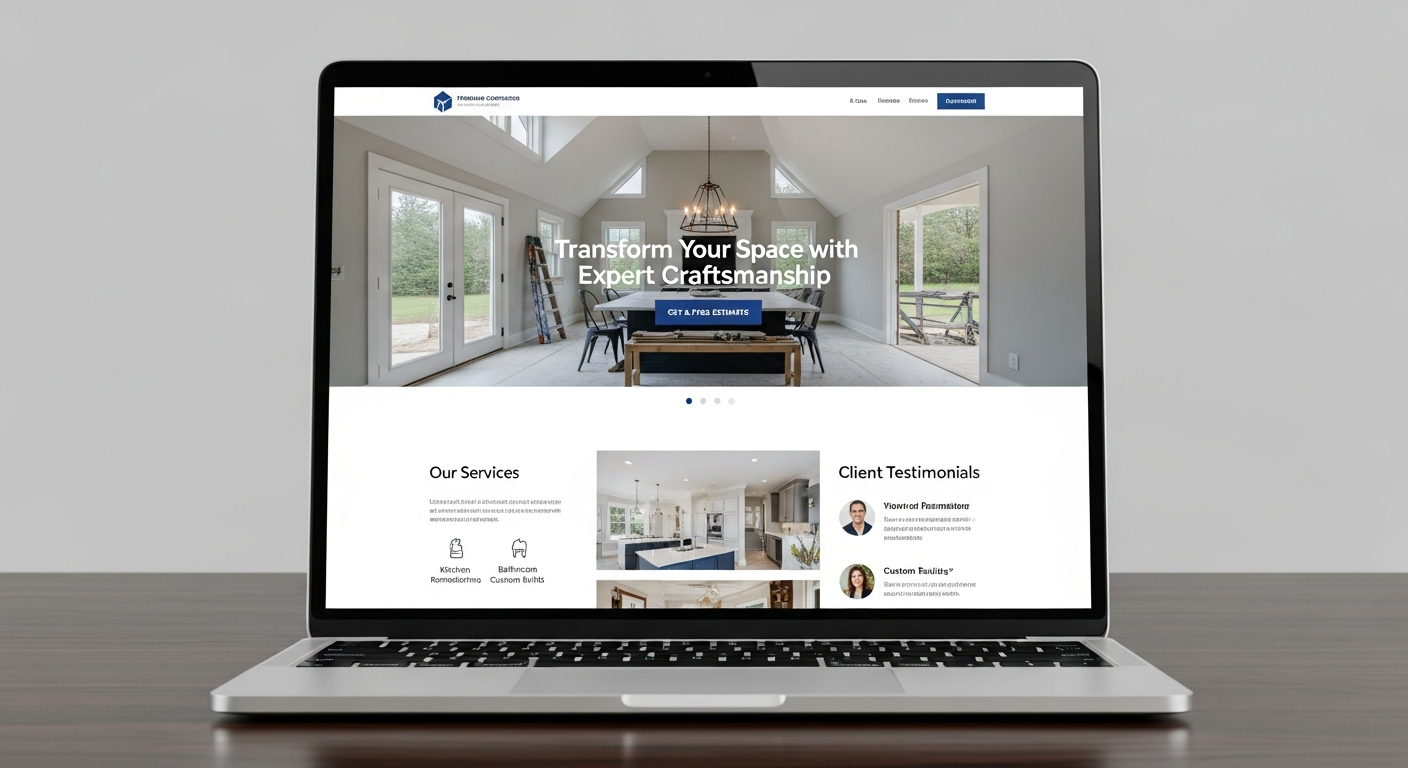
Your website has 3 seconds to answer three questions: What do you do? Where do you do it? And why should I trust you? If the visitor cannot answer these questions within 3 seconds, they will leave and you will never get them back.
We use a persuasion sequence that leads with the business outcome, followed immediately by social proof and a zero-friction booking calendar. This architecture typically doubles the conversion rate of a standard contractor site because it removes the confusion and friction that cause visitors to bounce.
The conversion architecture is not just about the homepage. Every landing page, every service page, and every blog post should have a clear path to a booking action. If a homeowner reads your blog post about roof repair and there is no call-to-action at the bottom, you have wasted the visit. Every page should have a contextual CTA that matches the intent of the content.
The AI Response Engine: Speed as a Moat
In a competitive market, speed is the ultimate competitive advantage. Our AI agents engage leads within 30 seconds, 24 hours a day, 7 days a week. They answer qualifying questions, handle basic objections, and book the estimate directly onto your sales team's calendar. This speed moat protects your leads from being stolen by faster competitors.
The AI response engine is not a chatbot that frustrates users with canned responses. It is a conversational system trained on your business data that can handle common homeowner questions about service areas, project types, financing options, and availability. When the conversation requires human expertise, like negotiating price or assessing a complex project, the AI seamlessly hands off to a human sales rep with full context of the conversation.
The engine also handles the states that most contractors ignore:
- No response: If a lead does not respond to the initial SMS, the system follows up with a different angle 24 hours later.
- No-show: If a homeowner misses their appointment, the system automatically sends a rebooking link.
- Not interested: If a lead explicitly opts out, the system stops all communication and tags them for future reactivation.
- Reschedule: If a homeowner needs to reschedule, the system offers alternative times without requiring a phone call.
Data-Driven Decisions: Measuring What Matters
The Growth Engine provides a single source of truth. Your dashboard tracks the metrics that actually matter, not vanity metrics like clicks and impressions:
- Cost per booked appointment: The real cost of a sales opportunity, including ad spend, CRM costs, and AI follow-up costs.
- Show rate: How many homeowners actually show up for the estimate. A low show rate indicates a qualification or reminder problem.
- Close rate: How many estimates result in a signed contract. A low close rate indicates a sales process or pricing problem.
- Revenue attribution: Which specific ad creative, campaign, and channel led to each closed job and its dollar value.
- Pipeline velocity: How long it takes for a lead to become a closed job, measured at each stage of the funnel.
When you can see which ad creative produced the $20,000 job versus which one produced the $2,000 job, you can optimize your spend toward the high-value projects. Without this data, you are guessing. With it, you are making decisions based on actual revenue, not assumptions.
Implementation Order for Fragmented Businesses
If your marketing is currently fragmented across multiple vendors and systems, do not try to integrate everything at once. Start with the highest-impact connection and build outward:
- First, connect your website to your CRM. This ensures that every lead is captured and that your sales team is notified instantly. This alone will recover leads that are currently being lost.
- Second, implement AI follow-up. This ensures that every captured lead gets an immediate response, 24/7. This will increase your lead-to-appointment conversion rate.
- Third, set up revenue attribution. This tells you which channels are producing revenue so you can reallocate budget from what is not working to what is.
- Fourth, align your ad messaging with your website. Ensure that every ad campaign sends traffic to a landing page that matches the ad's promise. This will increase your landing page conversion rate.
- Fifth, implement offline conversion tracking. Feed closed-job data back to your ad platforms so the algorithms can optimize for revenue, not just leads.
Each step builds on the previous one. Do not skip steps. A beautiful website without CRM integration is a brochure. A CRM without AI follow-up is a database. An ad campaign without revenue attribution is a guess. The power is in the connection.
What the Client Must Still Do
An integrated growth engine does not replace the client's responsibility to communicate, attend, estimate, follow up, close, and deliver. The engine generates qualified opportunities and ensures they are captured and nurtured. But the human elements of the sales process cannot be automated:
- The client must show up to booked appointments on time and prepared.
- The client must run professional estimates that build value before price.
- The client must follow up on unsold estimates with a personal touch.
- The client must close the business by asking for the sale.
- The client must deliver high-quality work that generates referrals and reviews.
The engine and the client are partners. The engine handles the predictable, repetitive work of capturing, qualifying, and nurturing leads. The client handles the important human work of building relationships, solving problems, and closing deals. When both sides fulfill their responsibilities, the system produces predictable, profitable growth.
The 12-Month Engine Deployment Roadmap
Phase 1: Infrastructure
Build your high-converting website with embedded booking calendars and connect it to your CRM. Set up baseline tracking, the Conversions API, and AI follow-up sequences. This phase takes 30 to 60 days and is the foundation everything else depends on.
Phase 2: Demand Launch
Launch targeted Google and Meta campaigns with strict service-area controls and qualification questions. Start building local SEO authority through Google Business Profile optimization and review automation. This phase takes 60 to 90 days.
Phase 3: Scaling and Optimization
Review revenue attribution data to identify which channels and creatives are producing the highest-value jobs. Scale the winning channels by 20 percent every 2 weeks. Implement advanced AI features for 24/7 sales support and database reactivation campaigns.
Building a Resilient Business
An integrated growth engine does not just generate leads. It builds a resilient, predictable business that is not dependent on any single channel or individual. When your ads, website, CRM, and analytics work as one system, you can scale with confidence because you know exactly what it costs to acquire a customer and exactly what that customer is worth. If you want to build that engine, explore our services or book a strategy session to discuss your specific business.