Direct Answer: Google Ads for concrete and deck contractors is a high-intent search strategy that captures homeowners actively looking for installation and repair services. By using commercial-intent keywords, implementing strict negative keyword lists to filter out DIYers, and using high-converting landing pages with project-specific social proof, contractors can generate qualified estimate requests at a predictable cost. This guide provides a tactical campaign blueprint for concrete and deck businesses, with separate checklists for each trade.
What You Need to Know
Why Search Intent Is the Secret Weapon for Project-Based Contractors
Unlike social media, where you are interrupting a user's day, Google Search captures active intent. The user is telling you exactly what they want. "Concrete driveway contractor" means they are ready for an estimate. "How to fix a crack in concrete" means they are a DIY researcher. Your ads must focus on the former and avoid the latter.
This intent distinction is the entire value proposition of Google Ads for project-based contractors. When someone searches "custom deck builder near me," they are not browsing. They have a project in mind and are looking for someone to do it. The question is not whether they need a deck. The question is which contractor they will call. Your ad needs to be the first one they see and the most compelling one they click.
The tradeoff is cost. High-intent search traffic is expensive because every competitor in your market is also bidding on it. A concrete driveway keyword might cost $8 to $15 per click in a competitive market. If your landing page converts at 10 percent, your cost per lead is $80 to $150. Whether that is profitable depends on your average job value and close rate. A $15,000 driveway project can absorb a $150 lead cost easily. A $500 repair job cannot.
Service Segmentation for Concrete and Deck Campaigns
One of the biggest mistakes contractors make is putting all their services into one ad group. You need to segment your campaigns to ensure message match. A "Concrete Driveway" ad should lead to a "Concrete Driveway" landing page, not a general "Home Improvement" page.
Concrete Campaign
- Driveway Installation and Repair
- Stamped Concrete Patios
- Foundation and Slab Work
- Retaining Walls
- Concrete Floor Polishing
- Commercial Flatwork
Deck Campaign
- Custom Deck Design and Build
- Composite Decking (Trex, TimberTech)
- Deck Replacement and Repair
- Multi-Level Decks
- Deck Staining and Sealing
- Pergola and Shade Structures
Each service should have its own ad group with keywords, ad copy, and a landing page that match the specific service. This message match is critical. If a homeowner searches "stamped concrete patio" and lands on a page about driveway installation, they will bounce. The landing page must show stamped concrete patio photos, answer questions about stamped concrete, and have a form or booking calendar specific to that service.
Keyword Architecture and Match Types
We primarily use phrase match and exact match to maintain control over lead quality. Broad match often brings in too much junk traffic for local service businesses. We also maintain strict negative keyword lists to filter out terms that indicate the searcher is not a potential customer.
Essential negative keywords for concrete and deck contractors:
- "how to" (DIY researchers)
- "supplies" (people looking to buy materials)
- "rental" (people looking to rent equipment)
- "cheap" (price shoppers who will not pay for quality)
- "jobs" (job seekers)
- "salary" (job seekers)
- "careers" (job seekers)
- "classes" (people looking for training)
- "cost per square foot" (researchers, not buyers, though some may convert)
- "ideas" (inspiration seekers, not ready to buy)
Review your search term report weekly for the first 30 days and add any irrelevant terms to your negative keyword list. This is an ongoing process. As your campaign runs, you will discover new negative keywords that you could not have predicted.
Ad Copy and Offer Strategy: Selling the Consultation
Your ad needs to give the searcher a reason to click. Use benefits and specificity. "Custom Deck Builder in [City] - 10 Year Warranty - Financing Available" is far more effective than "We Build Decks." Always mention your service area and any certifications to build immediate credibility.
Effective ad copy elements:
- Headline: Service + City (e.g., "Concrete Driveway Contractor in [City]")
- Subheadline: Benefit or offer (e.g., "Free Estimates - Financing Available")
- Description: Trust signal and specificity (e.g., "Licensed and insured. 15 years of experience. Call today for a free quote.")
- Extensions: Sitelinks to specific service pages, call extension for mobile, and location extension for map pack integration
Landing Page Requirements: The Conversion Engine
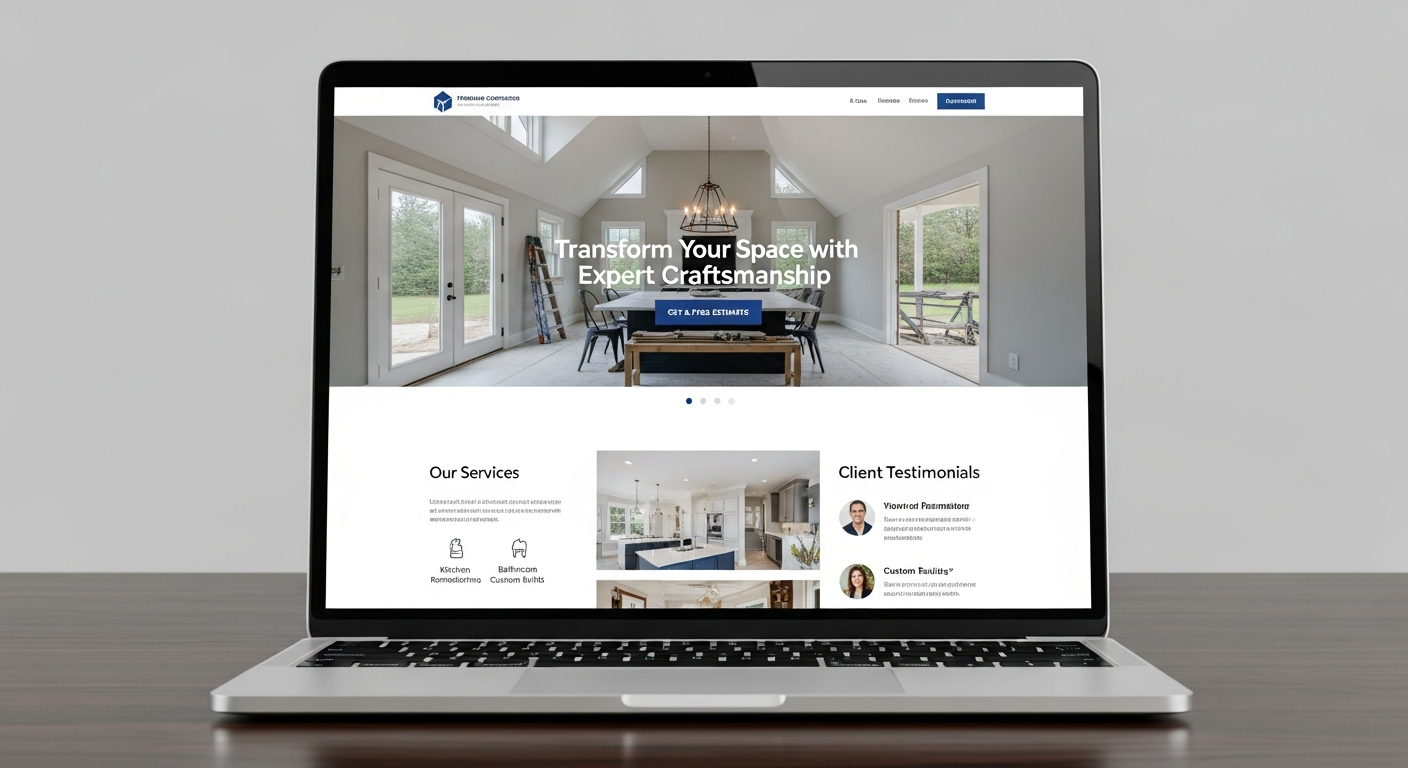
Do not send ad traffic to your homepage. Use a dedicated landing page that matches the ad. This means a headline that matches the keyword, a high-resolution hero image of a finished project, and a short form that captures the essential information needed for an estimate.
Essential landing page elements for concrete and deck contractors:
- Headline: Matches the ad keyword exactly. If the ad says "stamped concrete patio," the headline says "Stamped Concrete Patios in [City]."
- Hero image: A high-resolution photo of a finished project of the same type the searcher inquired about.
- Trust signals: Licensed and insured badge, Google review count and rating, and years of experience.
- Project gallery: 5 to 10 photos of similar projects with brief descriptions.
- Form or booking calendar: Short form with 3 to 4 fields, or an embedded calendar for direct booking.
- Click-to-call button: Prominent on mobile for searchers who want to call immediately.
Lead Qualification: Protecting Your Sales Time
Not every click is a good lead. We use custom questions on your landing page forms to filter for homeowners, budget ranges, and project urgency. By adding these questions, you ensure your sales team is only talking to high-value prospects.
Recommended qualification questions:
- Are you the property owner? (Filters out renters and researchers)
- What is your approximate project budget? (Filters out leads below your minimum)
- When are you looking to start? (Filters out leads who are not ready to act)
- What is the approximate size of the project? (Helps the sales team prepare for the estimate)
Bidding Strategy: Max Conversions vs Target CPA
Google's AI bidding is powerful, but it needs data. We start most campaigns on Maximize Conversions to gather baseline data. Once we have enough conversion volume (typically 30 or more conversions per month), we switch to Target CPA (tCPA) to lock in your lead costs and ensure long-term profitability.
The transition from Maximize Conversions to tCPA is a critical moment. If you switch too early, before the algorithm has enough data, your performance will drop. If you wait too long, you may be overspending on inefficient conversions. The rule of thumb is 30 conversions per campaign per month before switching to tCPA.
Conversion Tracking: Closing the Loop
You must track phone calls and form submissions separately. We use Dynamic Number Insertion (DNI) to see which keyword led to which phone call. This allows us to optimize for the search terms that actually result in signed contracts, not just clicks.
Essential tracking setup:
- Form submission tracking: Track every form submission as a conversion in Google Ads.
- Call tracking with DNI: Show a unique phone number for each ad campaign so you know which campaign generated the call.
- Offline conversion tracking: Push closed-job data from your CRM back to Google Ads so the algorithm can optimize for revenue, not just leads.
- Google Analytics 4: Connect GA4 to your Google Ads account for cross-platform attribution and audience insights.
Concrete Contractor Google Ads Checklist
- Separate campaigns for residential vs commercial work
- Dedicated landing pages for driveways, patios, foundations, and stamped concrete
- Negative keyword list with DIY, supplies, rental, and job-seeking terms
- Call tracking with Dynamic Number Insertion on every landing page
- Qualification questions on forms (homeowner, budget, timeline, project size)
- Offline conversion tracking connected to your CRM
- Ad extensions including sitelinks, callouts, and structured snippets
- Weekly search term review for the first 30 days to build negative keywords
Deck Contractor Google Ads Checklist
- Separate campaigns for new builds vs repair and staining
- Dedicated landing pages for composite decking, wood decking, and deck repair
- Negative keyword list with DIY, supplies, plans, and ideas terms
- Call tracking with Dynamic Number Insertion on every landing page
- Qualification questions on forms (homeowner, budget, timeline, deck size)
- Financing options prominently displayed on landing pages
- Project gallery with photos of similar deck styles (composite, wood, multi-level)
- Offline conversion tracking connected to your CRM
Budget Guidance Based on Unit Economics
Budget recommendations are not one-size-fits-all. They depend on your cost per click, conversion rate, close rate, and average job value. Here is a framework for calculating your minimum viable budget:
If your average CPC is $10, your landing page converts at 10 percent, and you need 10 leads to close 1 job, you need 100 clicks to close 1 job. At $10 per click, that is $1,000 in ad spend per closed job. If your average job value is $15,000 and your gross margin is 40 percent, your gross profit is $6,000. Spending $1,000 to make $6,000 is a 6x gross profit ROAS, which is healthy. If your numbers are different, adjust accordingly.
Start with a budget that allows you to collect enough data to make decisions. A budget that produces fewer than 100 clicks per week is too low to optimize. Increase the budget until you have enough data, then optimize before scaling further.
The 12-Month Google Ads Roadmap
Months 1 to 3: Data Gathering
Launch your segmented campaigns with a controlled budget. Focus on building your negative keyword list and optimizing landing page conversion rates. Track calls and forms separately with DNI. Establish your baseline cost per lead and cost per closed job.
Months 4 to 6: Optimization
Switch to Target CPA bidding to stabilize lead costs once you have 30+ conversions per month. Test advanced ad features like lead form extensions and dynamic search ads for long-tail queries. Start feeding offline conversion data to optimize for revenue.
Months 7 to 12: Scaling
Expand budget into high-performing service areas. Implement full offline conversion tracking to optimize for revenue rather than leads. Scale successful landing pages into new service areas. Review and refine your negative keyword list quarterly.
Winning the Search Game
Google Ads is the fastest way to put your concrete or deck business in front of buyers. By focusing on search intent, rigorous filtering, message match, and conversion-optimized landing pages, you can build a lead generation machine that delivers high-ROI jobs on demand. If you want to build that machine, explore our Google Ads service or book a strategy session to discuss your specific market.